Home » Building Survey » Building Surveyor Appleton
Oakfield Surveyors can help if you need a Building Surveyor in Appleton, Oxfordshire, with advice that starts by matching the right survey level to the property’s age, condition, alteration history and overall level of risk.
We are RICS chartered surveyors covering Appleton and the rest of Oxfordshire from our Oxford office. For many newer or well-maintained homes with limited alteration history, a Level 2 Home Survey may provide a suitable level of detail. For older, altered, extended or higher-risk properties, a Level 3 Building Survey is often the more appropriate choice because it gives a fuller visual assessment of the building.
We explain our findings in plain English, so you can think clearly about repairs, further enquiries and future maintenance before deciding on your next steps. Before we inspect, we will help you choose a sensible survey level for the Appleton property, so the advice is proportionate to the building and the questions you need answered.
OR CALL US ON: 01865 570768

Years serving the Home Counties
Surveys and valuations completed
Chartered surveyors, regulated by RICS
An Appleton buyer or homeowner should treat the survey as independent property advice, not as a formality attached to a mortgage or conveyancing file. We inspect and report with the property’s age, construction, condition and risk profile in mind.
Appleton is a village in the Vale of White Horse district of Oxfordshire, about four miles north-west of Abingdon, in the civil parish of Appleton-with-Eaton. Homes in and around the village range from old houses and cottages to twentieth-century and more recent houses, so we do not assume one survey type suits every instruction.
Our surveyors are Members of The Royal Institution of Chartered Surveyors, using the MRICS designation. We work to recognised professional standards, and our advice has to be clear enough for you to use when deciding what to do next.
We communicate plainly before and after the inspection. If you prefer email or text for routine points, we can work that way, and we use modern technology where it helps us understand the property and explain our findings.
Good survey advice should be proportionate. A newer, well-kept house with limited alteration history may need a different level of reporting from an older cottage, a heavily extended home or a property showing movement, damp or roof concerns.
If you are comparing what to look for before instructing anyone, our guide on how to choose a surveyor explains the practical checks that help you make that decision.
We are RICS chartered surveyors covering Appleton, Oxfordshire, Buckinghamshire, Berkshire, Hertfordshire and London. Call 01865 570768 or tell us about the property and your timetable and we will confirm the scope and fee before you commit.
Your building survey in Appleton is carried out by an RICS chartered surveyor. Nick and James lead our survey and valuation work across Oxfordshire and the surrounding counties.

Nick brings a wealth of experience to Oakfield, having worked in several large multi disciplinary practices in London. Nick specialises in Residential property and has a particular interest in complex Building Surveys, neighbourly matters and Level 2 survey reports.
Nick has developed a good relationship with repeat clients, Solicitors and Estate agents by giving honest and expert advice.

James is a chartered surveyor (MRICS) with over 20 years’ property related experience. He is an RICS Registered Valuer and focuses on the residential sector undertaking a range of valuations as well as Level 2 (Homebuyer) and Level 3 (Building Surveys). He has a particular interest in non-traditional properties. Alongside this he also deals with party wall matters party wall appointments acting for both Building Owners and Adjoining Owners in respect of development proposals. James is a member of the Pyramus and Thisbe Club and Faculty of Party Wall Surveyors, both of which are bodies promoting education and best practice in Party Wall matters.
Risk should drive the choice. You choose between a RICS Level 2 Home Survey and a RICS Level 3 Building Survey by looking at property complexity and risk, not just budget or lender expectations. We will ask about the property type, apparent age, alterations, condition and anything already worrying you before we advise which route fits.
| Decision point | Level 2 Home Survey | Level 3 Building Survey |
|---|---|---|
| When we usually recommend it | Newer homes or well-maintained properties with limited extensions or alterations. | Older, altered, extended, unusual or higher-risk properties. |
| What our report gives you | A condition-led report using a traffic light system to show the relative seriousness of issues in each element. | Fuller descriptions of defects, likely causes and suitable remedial options where visual evidence supports them. |
| How it helps your decision | It helps you identify visible condition concerns and decide whether any issue needs clarification before you commit further. | It helps you understand the building fabric, the seriousness of defects and the kind of repair approach that may be suitable. |
| Typical Appleton properties | Later twentieth-century and recent houses in and around the village that appear well kept. | Older cottages and period houses, heavily extended homes, and any property showing movement, damp or roof concerns. |
Where your concern is a single, already-identified issue, a Specific Defect Report may be the better instruction; see below.
In a RICS Level 3 Building Survey, we carry out a thorough visual inspection of the main building elements and report on their condition, defects and likely significance. Our report treats the property as a building, not just as a list of rooms, and sets out what we have found, why it matters and what repair or investigation steps are sensible.
We inspect walls, floors, roof structure and coverings, doors, windows, cellars where present, garages and permanent outbuildings where relevant. We also consider signs that may indicate movement, including cracking, distortion and other subsidence indicators.
Damp is part of our condition review. We use suitable tools where appropriate, such as moisture meters or thermal imaging, to support our visual inspection rather than to open up the building or test concealed construction.
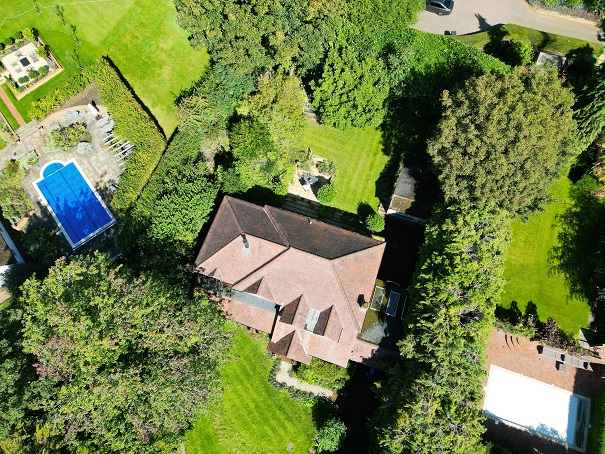
Where access, safety and the instruction make it suitable, we may use drone or pole-camera imagery to improve our view of roof areas. Our note on whether we go into the loft explains how access and safety affect that part of the inspection.
We consider health and safety issues, means of escape and relevant environmental risk factors, including flood risk information, suspected asbestos, energy efficiency issues, noise context and available radon information, without turning the survey into a specialist environmental assessment.
Services are considered visually as part of the overall condition review. We look for signs of age, disrepair, unsafe installation or the need for further checks, but we do not test gas, electrical systems, plumbing or drains.
Our report sets out the findings, the likely cause where it can be judged, and the repair or investigation steps that are sensible, with photographs and plain-English explanation so you can brief contractors, specialists or your solicitor.
Tell us the property address, a brief description of the home and your timetable, and we will confirm scope, fee and timescale before any work is agreed. Call 01865 570768 or email info@oakfieldsurveyors.co.uk.
When an Appleton property is old, traditional or period in character, we need to understand how it was built before we judge what is wrong. We do not judge it by modern-house assumptions.
Appleton has buildings of great age, including a manor house dating from about 1200 and a parish church whose oldest parts are twelfth-century. That local context does not make every home historic, but it does mean older construction is a realistic consideration for buyers and homeowners in and around the village. Our historic building surveys page explains how we approach period construction.
We pay close attention to solid walls and how they manage moisture. Damp in older buildings may relate to ground levels, ventilation, finishes, rainwater goods, past repairs or the use of materials that do not suit the original construction.
Timber matters. We inspect accessible timber elements for signs of decay, beetle attack, distortion and moisture-related deterioration, and we consider how roof structure and roof coverings are performing together.
Chimneys, later extensions and previous alterations can materially affect condition and future repair choices. We also look for signs that modern repair materials may be trapping moisture or changing how the building fabric works.
If a property is listed or lies in a conservation area, repairs and alterations may need consent. We will flag visible issues that may have planning or conservation implications, and you should check consent requirements with the local planning authority and your solicitor.
A building survey is a visual, non-invasive inspection, so it does not replace specialist testing or opening up works. Our report states what we can see and safely access, and where visible evidence points to further investigation.
A Specific Defect Report is more appropriate than a full home survey when the concern is narrow and already identified. We use it to answer a defined question rather than to review the whole property condition.
You might instruct us for a crack, damp patch, roof concern, chimney issue, suspected movement or a concern that has appeared after building work. Tell us the specific concern, and our inspection and report will focus on that stated defect.
A structural inspection may be the better route where the main concern is movement, distortion, load paths, roof spread or alteration of structural elements. If you are buying the whole property and want to understand wider condition risk, a Level 3 Building Survey is usually the more complete route; we will tell you if a focused report would leave too many wider questions unanswered.
Send us the address, property type, age if known, and where you are in the purchase or ownership process. For Appleton and other Oxfordshire enquiries, call 01865 570768 or email info@oakfieldsurveyors.co.uk.
Tell us about cracks, damp, roof issues, alterations, extensions or anything raised by the seller, agent, solicitor or lender.
We can advise whether a Level 2 Home Survey, Level 3 Building Survey or focused defect report is the better match for the property and the decision you need to make.
Our Oxfordshire office address is Prama House, 267 Banbury Road, Summertown, Oxford OX2 7HT. Instruct us before exchange pressure builds, so there is time for any further investigation our report recommends.
We have offices in Oxford, Beaconsfield, Henley-on-Thames, Rickmansworth and London and work throughout Oxfordshire, Buckinghamshire, Berkshire, Hertfordshire and London. For Appleton enquiries call our Oxford office on 01865 570768.
No, the survey is a private report for the purchaser who instructs it. You may choose to disclose parts of our report to the seller if you are negotiating over defects, repairs or the purchase price, but that is your decision. We write the report for you, so you can use it in the way that best supports your purchase discussions.
It depends on the purchase negotiation. Sometimes the seller arranges works before completion, and sometimes the buyer negotiates the price to reflect the issues our survey has identified. We give you clear condition findings so you can discuss the next step with your solicitor and the seller’s side.
In most cases, yes: we will go into the loft where access and safety allow. Loft inspection helps us assess visible roof structure, hazards, use of space and issues that could affect future works. If access is unsafe, obstructed or unavailable, we record that limitation in our report and explain why it matters.
Alternatively please call us on 01494 926236.
One of our team of professionals would be delighted to help you with any queries.
